
Understanding anal fistula
An anal fistula is a small tunnel that forms between an infected gland inside the anus and an opening in the skin nearby. It almost always begins as an anal abscess: once the abscess drains, a channel can be left behind that keeps leaking and refuses to heal on its own.
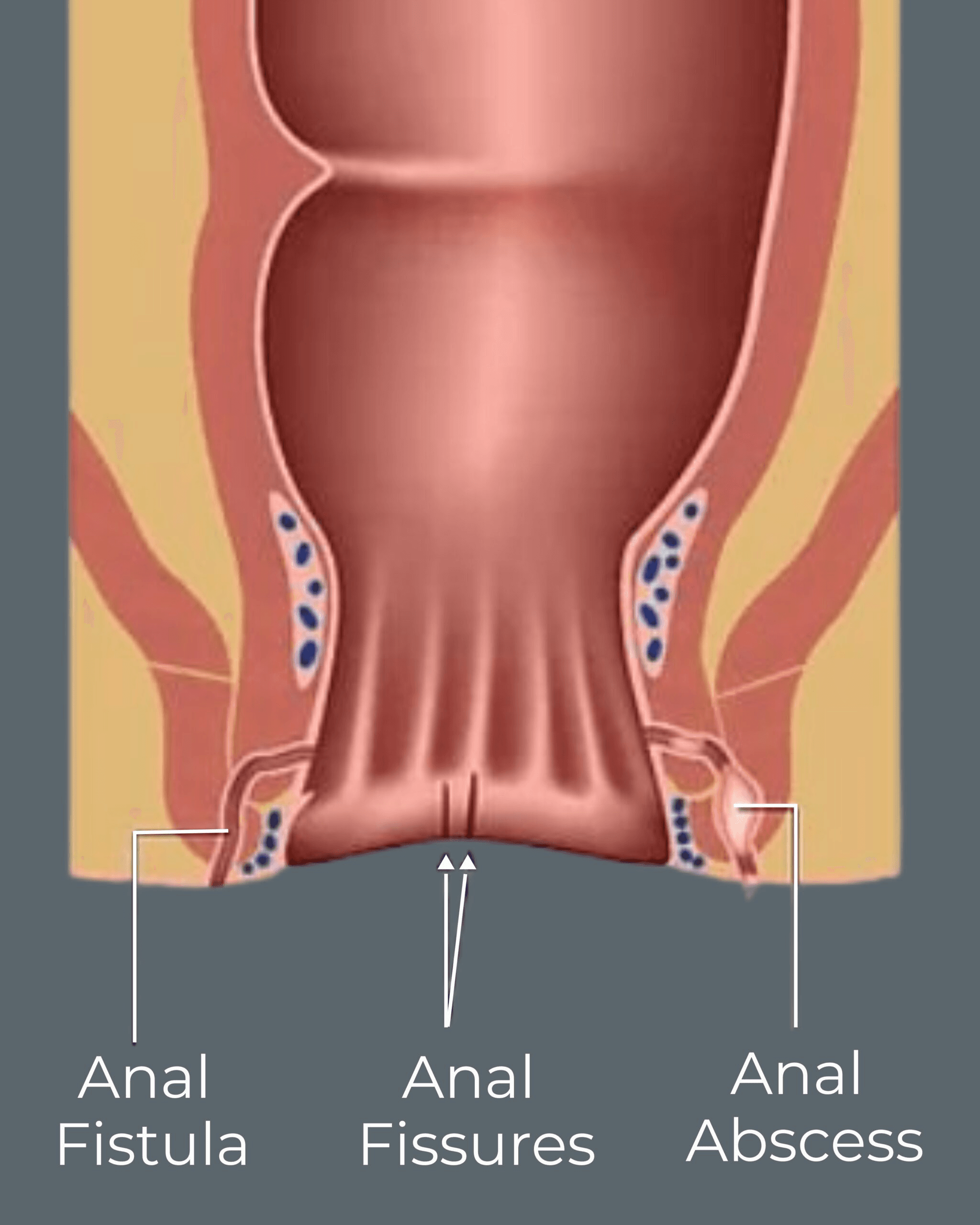
How a fistula forms
Gland infection
A tiny gland inside the anus becomes blocked and infected.
Abscess forms
The infection builds into a painful abscess that drains — bringing relief.
A tunnel remains
A channel is left behind between the inside and the skin — the fistula, which won’t close on its own.
Types of anal fistula
Not all fistulas are the same. Their type and complexity guide the safest way to treat them while protecting the muscles that control continence:
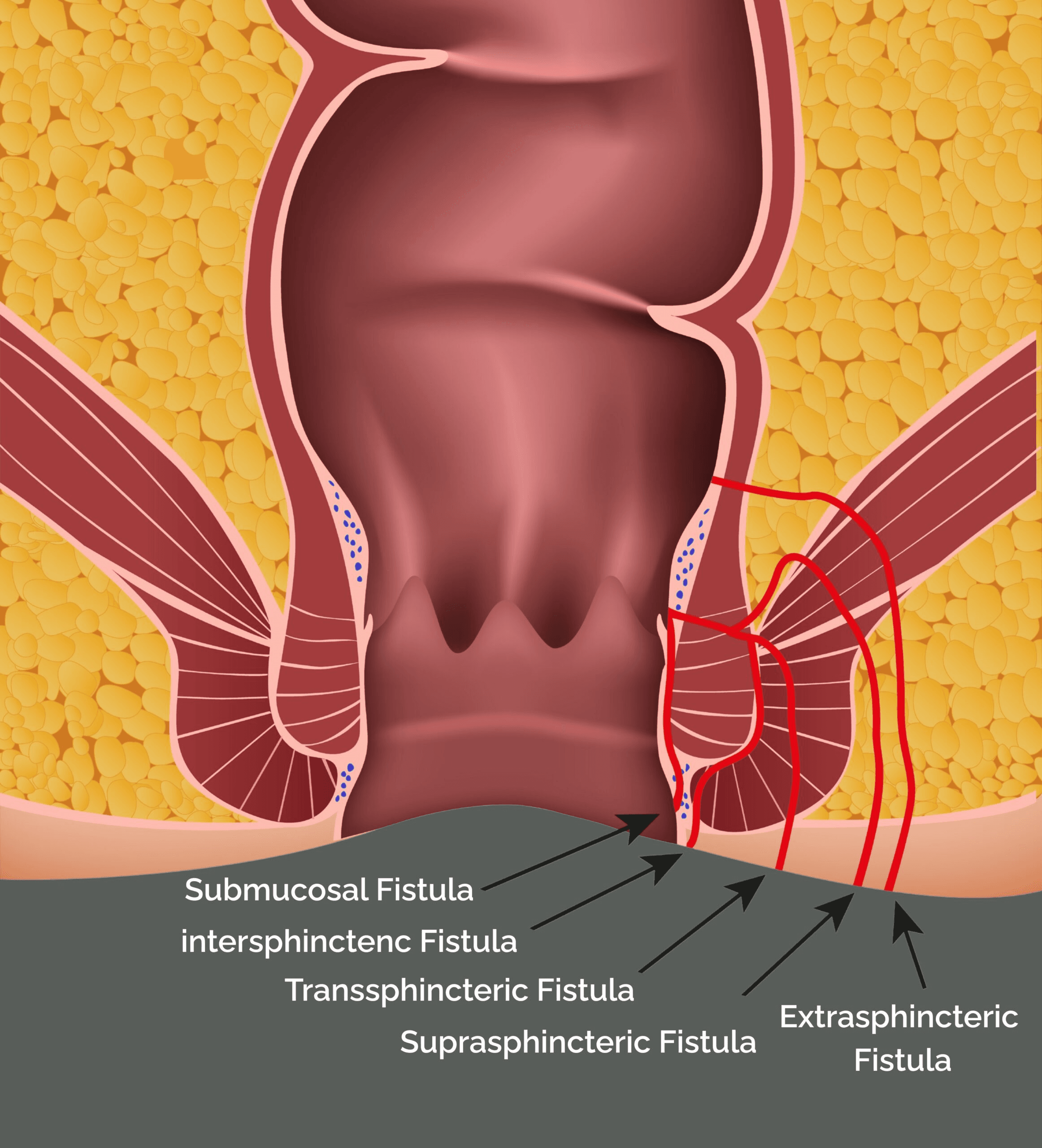
Simple (low)
A single, straight tract that runs below most of the sphincter muscle — generally the easiest to treat.
Complex (high)
Involves more of the sphincter, sits higher, or has more than one branch — needs a carefully tailored approach.
Recurrent
A fistula that has returned after previous surgery, where preserving the muscle is especially important.
FiLaC® — Laser Fistula Closure
FiLaC® Laser ClosureFiLaC® (Fistula-tract Laser Closure) is a modern, sphincter-preserving alternative to traditional cutting surgery (fistulotomy or seton). Where needed, the tract is first mapped with ultrasound or MRI. A fine laser fibre is then passed along the fistula and delivers gentle, controlled radial energy that destroys the lining and seals the tunnel from the inside — without cutting through the muscles that keep you continent. The procedure takes around 30–45 minutes.
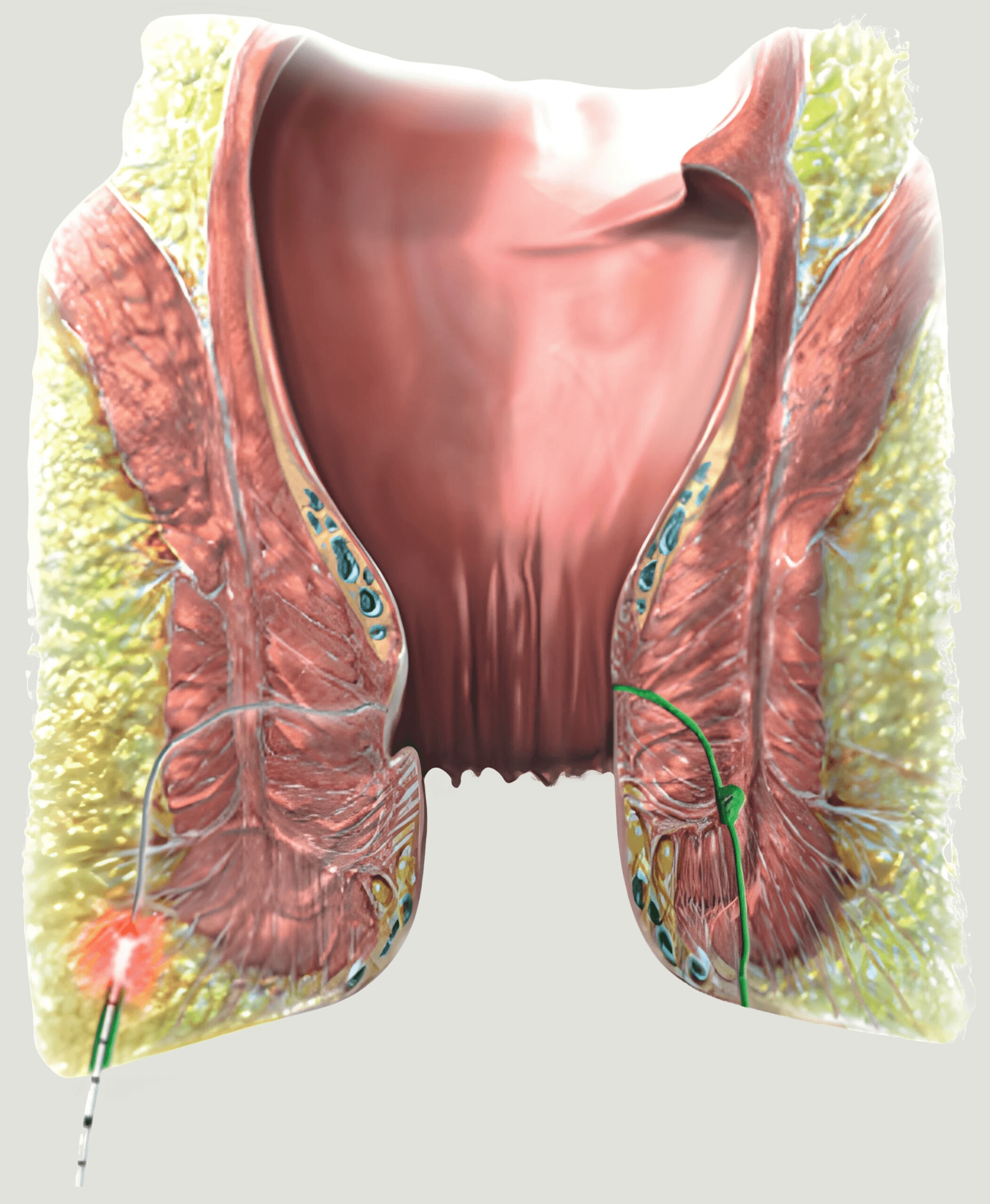
Sphincter-preserving
The muscles that control continence are protected — the key advantage over lay-open surgery.
Minimally invasive
No large open wound and no lengthy packing or dressing regimes.
Same-day procedure
A day case of about 30–45 minutes; most patients walk out the same day.
Repeatable & low-risk
A low complication rate, and the treatment can be safely repeated if needed.
Why our patients choose laser
The same conditions, treated two very different ways. Here is how minimally invasive laser compares with traditional open surgery.
Recovery times are typical and vary by patient and condition.
Why patients choose laser
A gentler alternative to conventional surgery, built around your comfort, privacy and a fast recovery.
No cutting, no stitches
Laser precision means minimal wounds and far less pain than traditional surgery.
Walk in, walk out — same day
Most procedures are done under local anaesthetic as a day case. No overnight stay.
Back to work in 24–48h
A faster, gentler recovery so you can return to daily life quickly.
Powered by Biolitec®
ELVeS® Radial® laser technology from the pioneers of minimally invasive laser care.
Discreet & confidential
A calm, private clinic and a compassionate team — your comfort comes first.
15+ years of expertise
A board-certified surgeon specialising in proctology and laser techniques.
We understand your concerns
An anal fistula is uncomfortable, persistent and understandably worrying. These are the questions patients ask us most — and the honest answers.
Will I lose control of my bowels?
This is the number-one worry. FiLaC® is chosen precisely because it preserves the sphincter muscle, greatly reducing the incontinence risk of older cutting techniques.
Will it just come back?
Fistulas can recur, but assessing the whole tract and closing it while sparing the muscle gives the best chance of lasting healing — and treatment can be safely repeated if needed.
Is it dangerous to leave untreated?
An untreated fistula rarely heals alone and often causes repeated painful abscesses and infection. Treating it early is simpler and far more comfortable.
It’s embarrassing to talk about.
We see this every day. Your consultation is private, respectful and completely judgement-free.
Will my visit stay private?
Absolutely — a discreet clinic, confidential records and a calm, unhurried experience from start to finish.
I’d prefer a female surgeon.
You’ll be cared for by Dr. Tasneem Abu El Fuol, a female consultant surgeon who speaks both English and Arabic.
A calm, guided path from consultation to recovery
Consultation
Meet your specialist and discuss your concerns in complete confidence.
Diagnosis
A precise clinical assessment to confirm the right treatment for you.
Laser treatment
A swift, minimally invasive procedure — usually the same day.
Follow-up
Guided recovery and attentive aftercare until you are fully healed.

Dr. Tasneem Abu El Fuol
Dr. Tasneem is a highly skilled General and Laparoscopic Surgeon with over 15 years of experience, specialising in proctology and varicose vein treatment. She is known for advanced, minimally invasive procedures and a precise, patient-centred approach.
She earned her MD in General Surgery from the Jordan University of Science and Technology and is board-certified by the Jordanian Board of Surgery. Fluent in English and Arabic, she combines technical excellence with genuinely compassionate care.
- 15+ years’ experience
- Jordanian Board of Surgery
- Associate Fellow, American College of Surgeons (ACS)
- Member, Royal College of Surgeons Ireland (MRCSI)
- English & Arabic speaking
An extension of the renowned Biolitec®
Swift Day Surgery is built on decades of laser innovation. Biolitec® pioneered the ELVeS® Radial® minimally invasive laser systems now used worldwide — the same technology behind our swift, pain-free proctology treatments.

Dr. Wolfgang Neuberger
Involved in establishing the modern Biolitec® since 1988. He earned a doctorate in physics from the Technical University of Vienna and holds an MBA from INSEAD, Fontainebleau.
Fistula patients, treated with care
“After two abscesses I was terrified of surgery and of the after-effects. The laser procedure was quick, and my biggest worry — losing control — was never an issue. Healed well and no recurrence.”
“I had a fistula that kept coming back. Dr. Tasneem explained everything clearly and the sphincter-preserving approach finally sorted it out. Very discreet and professional.”
“No big wound, home the same day, and hardly any pain. I wish I had dealt with it sooner instead of living with the discharge and discomfort for so long.”
Illustrative patient stories — replace with your verified Google reviews before launch.
Anal fistula treatment — your questions
Take the first step — discreetly
Message us on WhatsApp or request a callback. Our team usually responds the same day.
MOH: HE3UM8K8-151025
Book a confidential consultation
Same-day callback. 100% discreet.